

State Comparisons, Where Is Montana In The Mix
October 3, 2026– Michael Marsh
After returning from National Comp in Las Vegas, the Oregon premium rankings were showed up in my LinkedIn feed. My curiosity was of course aroused because we have made some headway in the state. In 2007, Montana was ranked as the most expensive (pure premium per $100 of payroll) in the United States.
As part of the Governor's Advisory Council on Workers' Compensation, I was fortunate to have been involved in implementation of Utilization and Treatment Guidelines as well as two major revisions in the basic WC statutory structure in 2007 and 2011. Progress has been made despite three administrations representing both sides of the aisle that pushed for "no changes under my watch". That approach continues to resonate from Helena.
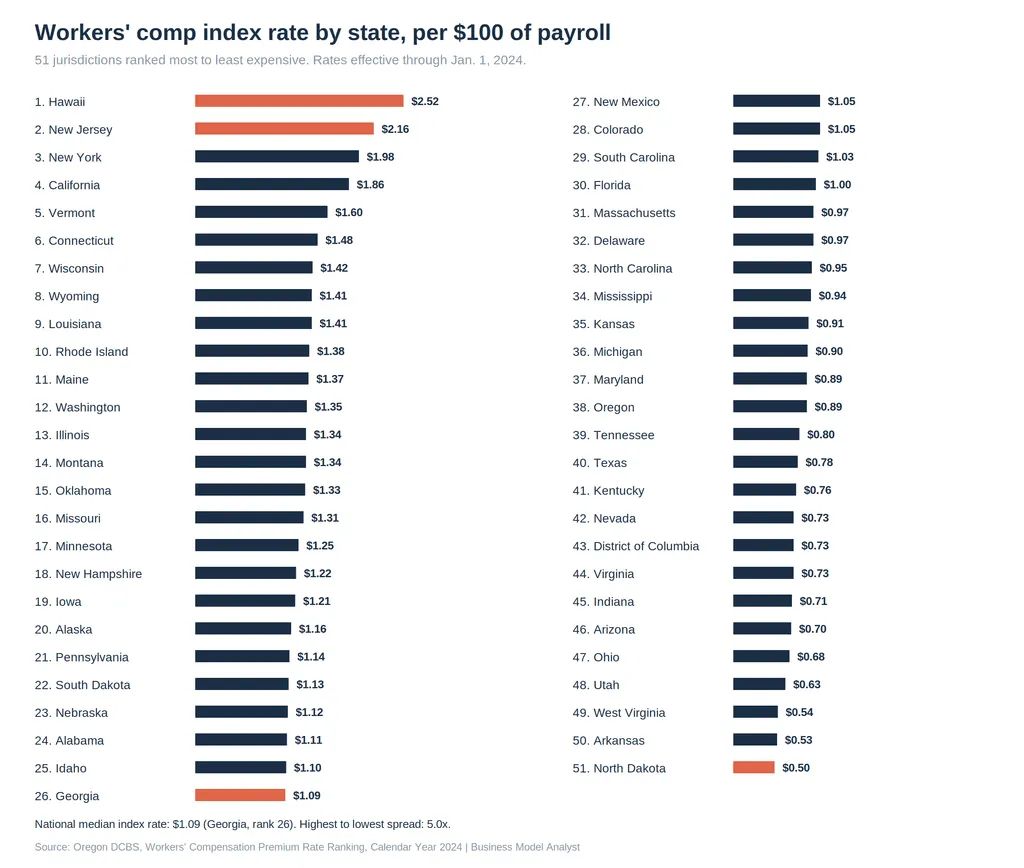
As is evident in the graph above, Montana is no longer at the top of the list of states, it is now showing as tied for the position of the 13th most expensive jurisdiction in the US. Real progress. Will the figures change from 2024 to 2026 as the study is updated?
Montana has improved. And when you are swimming in a self-contained small swimming pool, small waves may appear big...but may actually be smaller when compared to other pools. From the rate study,
- 2020 study (rates around January 1, 2020): national median $1.44 per $100 of payroll
- 2024 study (rates mostly in 2023–early 2024): national median $1.09
That is about a 24% drop in the median index rate in four years.
Montana stayed in the expensive half of the ranking and reduced less than the median.
Study: Montana index rate:
Rank (1 = highest) Share of national median
2020 $1.69 12 117%
2024 $1.34 14 122%
That is about a 21% decline ($1.69 to $1.34), versus about 24% for the national median. Montana’s rate fell, but other states fell a bit more, so its position relative to the median did not improve.
Where will Montana compare in the most recent, updated study? My guess is relatively the same. Rates have been falling in almost every state according to industry publications and insurance company profits continue to make workers' compensation among the top insurance lines. The workers' compensation line is very slow to change because of the long term nature of the liabilities...and actuaries are hesitant to advocate for any short term significant changes.
Further, in Montana, the figures are skewed a bit because of the make up of the workers' comp market. Montana's workers' compensation system is made up in the statutory structure as a 3 plan state. Plan 1 is approved self-insured organizations (one of the specialties of my claims company www.midlandclaims.com). Plan 2 is insurance companies including fronted organizations, captives, etc. And Plan 3 is the Montana State Fund ("MSF").
The distortion of the figures arises out of two factors: the size of the market and the concentration of business held by one entity.
The size of the market is and interesting factor. Montana is the 4th largest geographic state in the US...however, it has fewer businesses and population than Sacramento County California. Which means that Montana is essentially a rounding error in the workers' compensation industry. The entire US market is estimated to be in excess of $58 Billion. Montana is estimated (not including the healthy, substantial self-insured component) at just over $300 Million. The published NAIC share of all workers' compensation in the US for Montana is 0.50%. As stated, the market in Montana is essentially a rounding error when looking at the entire US.
Concentration of business within the state is an important consideration when considering the movement of rates compared to other states. In Montana, more than 60% of all insurance is written by one entity, Montana State Fund. Where goes the MSF rates, so goes the market. Since I was fortunate to have served on the board of MSF for the past 5 years, pure premium rates were reduced 34%. It is basic math, if 60% of the market reduces rates by 34%, there should be a significant movement in comparison to surrounding, competitive states. Here's where we stand today:
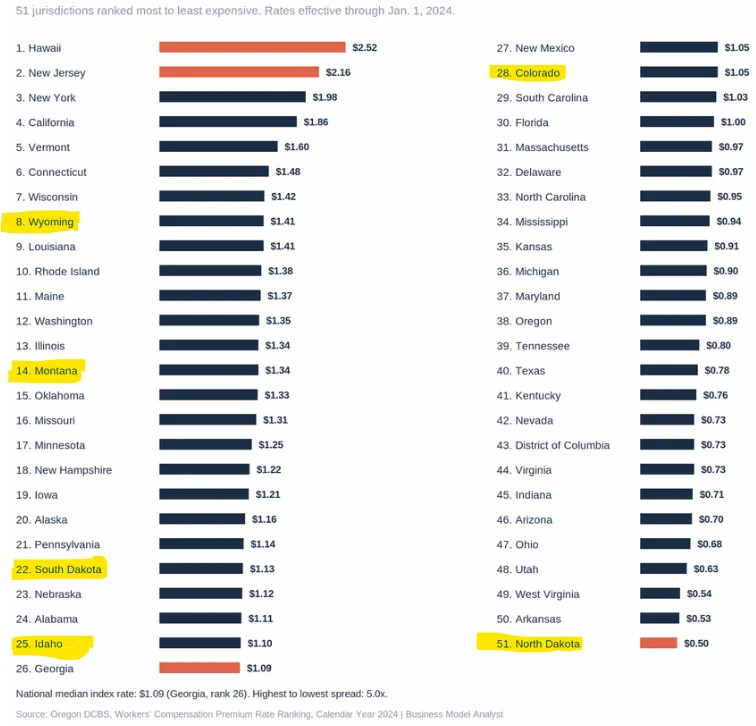
If a state sells itself with the reputation of being 'business friendly', the cost of workers' compensation will be in the conversation. And that conversation typically involves comparison to surrounding states that share much of the history, weather and distance to markets with Montana. One can see clearly that Montana is the second most expensive of surrounding, competitive states...only Wyoming has a higher pure premium rate. The difference of 5% might not be enough to matter to a new or relocating business. But the fact that there is no income tax in Wyoming and relatively high property and income taxes in Montana might be added to the evaluation.
For other states, the premium ranking may well be enough for a business to make a decision where to locate or relocate to. Choose Rapid City, South Dakota, only a 5 hour drive from Billings, and save 15% on your workers' comp premium. Choose Couer d'Alene, about 2 1/2 hours west of Missoula, Montana, and save 18%. Consider the oil extraction industry operating in eastern Montana and western North Dakota. Put your primary operations and payroll in Williston, North Dakota, less than 60 miles from Sidney, MT, and you'll save 63% on your workers' compensation insurance expense.
As the long-term rate reduction cycle comes to an end for the workers' compensation line, states high on the workers' compensation cost list will need to up the game at finding innovative, effective ways to mitigate the cost increases that are in front of us. These issues were fairly consistent in all of my conversations with many individuals at National Comp. The evolving challenges to claims costs include:
- Access to timely and appropriate medical care
- Consolidation of medical treatment providers and reduction of rural access sites
- Societal expectations of benefits provided by the system
- Confusion and lack of systemic knowledge of employers and injured workers
- Remote, non-face-to-face claims handling
- Consolidation of workers' compensation claims offices / entities through acquisitions
- Claim service decisions which do not include the full cost of the program
- Dropping mental / mental claims (such as PTSD) into the workers' compensation system without significant rules for qualification and restrictions as to longevity of benefits
Takeaway: Montana has made some progress at holding treatment standards high for recovering injured workers while squeezing out systemic, bureaucratic cost drivers. Moving from the most expensive jurisdiction before 2007 to a tie for 13th is progress. But $1.34 compared to $0.50 for our North Dakota next door neighbor...the state must do better if it hopes to remain competitive for business.